Filming in Norway

Where Efficiency Meets Epic Landscapes
Norway combines efficiency, accessibility, and strong local support. Norwegian crews are highly experienced, work lean, speak fluent English, and offer competitive rates—supported by modern rental houses with a complete technical pipeline. Mobile coverage is excellent nationwide.
With robust infrastructure and more than 50 airports, even Norway’s most dramatic locations are easy to reach—making it possible to film on a beach and a glacier in the same day. Norway is also a highly sustainable filming destination, powered by renewable energy and supported by one of the world’s leading electric vehicle fleets.
Local authorities are welcoming and solution-oriented, with film commissions and service companies ready to support permits, logistics, and government relations for productions of every scale.
Essential Information
Geography and Nature
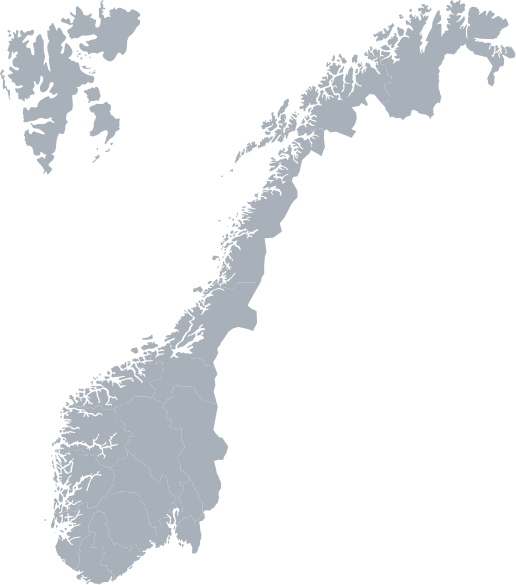
Norway’s geography features one of the most varied natural landscapes in Europe — with fjords, glaciers, mountains, forests, and over 50,000 islands along its rugged coastline.
This diversity allows productions to represent a wide range of global settings within one country. From the lush southern coast to the wild, snow-covered north, Norway offers endless visual possibilities.
Alpine tundra covers about 32% of the mainland, and the dramatic variation in vegetation, climate, and light conditions make it an ideal destination for film and TV productions seeking authenticity and visual impact.
Permits
Norway does not have a national film ordinance, and productions are not required to register with a government body.
Minimal-impact shoots in public areas and on uncultivated land outside of Oslo generally do not require permits. Permits are needed for activities involving:
- Closing or restricting public access
- Road closures or traffic control
- Use of motorised vehicles on uncultivated land
Filming in Oslo usually requires a permit. Contact the Oslo Film Commission for guidance.
Film Commissions can provide introductions, help manage government relations, and connect productions with local experts. All productions are encouraged to work with local production or location managers who can assist with applications to relevant authorities.
Drone Filming
Drone operations in Norway are regulated by the Norwegian Civil Aviation Authority (NCAA). Depending on the drone’s weight, productions must either:
- Submit an operating manual, or
- File a declaration to the NCAA.
The Safe to Fly database provides up-to-date information on restricted zones. For safety and compliance, productions should always work with a certified Norwegian drone operator.
Infrastructure
Norway has an extensive network of roads, bridges, airports, ferry routes, and railways, providing easy connections between all regions and direct access to Europe and beyond.
A list of the country’s 50 national and international airports is available at Avinor.
Flight Times
- 1.5 hours from London and Copenhagen
- 2 hours from Paris, Frankfurt, Amsterdam
- 7 hours from New York
- 14 hours from Los Angeles, Tokyo, Hong Kong
- 23 hours from Sidney
Value Added Tax (VAT)
In Norway, Value Added Tax (VAT / MVA) applies to all goods and services. Film production companies are not exempt.
However, goods and services provided to non-Norwegian productions can be invoiced without VAT.
If your company incurs VAT in Norway but is not registered in the Norwegian VAT register, you may apply for a VAT refund through the Norwegian Tax Authority.
Withholding Tax
Film crew hired by a foreign (e.g. American) production company for short-term projects are generally not liable for tax in Norway, as long as they are paid directly by the foreign company.
If wages are paid through a Norwegian production company, the general rule is that tax must be paid in Norway.
Svalbard
Svalbard lies midway between mainland Norway’s northern coast and the North Pole. It is part of the Kingdom of Norway, but is administered directly by the Norwegian government and has a special legal status under the Svalbard Treaty. Svalbard is outside the Schengen Area and the European Economic Area (EEA).
Productions should note:
- VAT does not apply to most goods and services purchased on Svalbard.
- No ATA Carnet is required for equipment arriving on direct flights to Svalbard.
- Commercial and private aircraft of all sizes can land, subject to airport operational requirements.
- No visa is required for direct travel to Svalbard. However, Schengen entry rules apply if travelling via mainland Norway.
- Under the current Norwegian film incentive regulations, expenses incurred on Svalbard are not considered costs “incurred in Norway.” This also applies to co-productions with foreign majority producers.
- However, costs linked to Norwegian mainland-based workers (e.g., insurance, travel, per diem, accommodation) may be eligible as Norwegian expenses.
- Companies or individuals registered on Svalbard are not eligible for national film grants or incentives.
Film Crews and Production Services
Norway offers highly experienced film crews and production service companies with extensive international experience across feature films, television series, commercials, documentaries, animation and high-end productions. Norwegian professionals have worked on major international projects and provide expertise across every department, from production assistants to heads of department.
Norway has the capacity to support productions of every scale. The country's experienced production service companies offer comprehensive local support, while modern technical infrastructure, specialist suppliers and established industry networks ensure productions can be delivered efficiently throughout the country. Norway also has the capacity to accommodate multiple large-scale international productions simultaneously.
Finding crew in Norway
Local production service companies maintain extensive networks of experienced crew and can assemble teams tailored to each production. In addition, several regional film commissions and film centres maintain crew databases that help international productions connect with skilled local professionals.
Professional organisations
Norway's film industry is supported by a number of professional organisations, including:
- Norwegian Film Workers Union (Norsk Filmforbund), representing approximately 1,400 professionals across all production departments
- Norwegian Actors' Equity Association
- Writers' Guild of Norway
- Directors Guild of Norway
Membership of these organisations is not mandatory, and there is no requirement for productions in Norway to employ union crew.
Facts and figures
5,641,754
Statistics Norway (SSB)-
Time Zone CET (GMT +1)1 US dollar in Norwegian kroner
1 Euro in Norwegian kroner
The Kingdom of Norway
Oslo Bergen, Trondheim, Stavanger, Tromsø
Norwegian
Norwegian Constitutional Monarchy, parliamentary system
385 155 sq km
100,915 km
Finland, Sweden, and Russia
From last sunday in March until last Sunday in October
+47
220 V 50 HZ
Visa & Work Permits for Film Productions
Non-Norwegian residents may work in Norway for up to 90 days without a work permit, provided that their on-screen work in the final production does not exceed 14 working days per person. This rule also applies to actors and essential support staff.
Preparation and post-production activities, such as test shoots or set construction, are not counted toward the 14-day limit.
EU/EEA and UK Citizens
- May stay in Norway up to 90 days per calendar year without a residence permit.
- May work on footage used in the final production for up to 14 days.
- For longer stays or more than 14 filming days, a work permit is required.
Applications for work permit can be found here: UDI: Residence Permit for Artists, Musicians or Performers
Processing time: approximately 40 weeks.
UK, US, Canada, India and Non-EU Countries
- Require a Schengen visa to enter Norway.
- The same 90-day stay / 14 filming-day rule applies once in the country.
- Productions must notify the local police before arrival, listing all non-Norwegian participants and filming dates (Immigration Regulation §1-1(12)). This can be handled by the Norwegian production company or organizer.
Visa Applications for Indian citizens
Indian film professionals without an existing Schengen visa can apply for either:
- Business Visa – recommended for professional film and TV work.
- Tourist Visa – also accepted for short-term filming visits.
Official guidance:
- Visitor Visa for Indian Citizens
- Work Immigration for Cultural Exchange, Artists and Performers (India)
Visa applications should include a letter specifying:
- Tentative dates of stay, program, and accommodation in Norway
- Who covers the costs (Indian or Norwegian company)
- Information about each applicant, including role in the production, passport number and date of birth, and contact details
Sustainable Filming in Norway
Norway is committed to facilitating sustainable film productions. The country offers incentives for eco-friendly practices, access to renewable energy, and stunning natural backdrops.
Norway makes sustainable production practical and cost-effective. Nearly all electricity comes from renewable hydropower, giving productions access to a clean and stable energy grid. Transport is also low-emission, with strong public transit in major cities and extensive rail connections—plus easy access to electric vehicles and charging nationwide.
Productions can further reduce their footprint by renting equipment locally instead of shipping internationally, choosing eco-certified accommodation and sustainable catering, and taking advantage of Norway’s high-quality tap water to avoid single-use plastics. Robust recycling systems and strict waste regulations support responsible production practices across the country.
Sustainability Requirements for the Film Production Incentive
The film production incentive provides grants that reimburse costs spent in Norway for international films and series produced entirely or partly in the country. As part of the application process, productions must include a plan for environmental measures before filming begins in Norway.
Right to Roam
Norway offers breathtaking and diverse nature, making it a stunning backdrop for film productions. The country’s Right to Roam (Allemannsretten) grants public access to nature, but it also comes with the responsibility to respect the land, wildlife, and local communities.
Sustainable filming in Norway requires minimizing environmental impact by adhering to guidelines on waste management, limiting motorized transport in protected areas, and ensuring wildlife is not disturbed. Planning shoots with sustainability in mind involves choosing eco-friendly transport, working with local crews, and securing the necessary permits.
Nordic Ecological Standard
The Nordic Film and TV industry is introducing a common Nordic Ecological Standard (NES) for sustainable production, to be implemented in all the Nordic countries from 2026.
Green Producers Tool
The Green Producers Tool (GPT) is a carbon footprint calculator designed to help the Culture and Creative Industries measure and reduce their greenhouse gas emissions. Developed in collaboration with CICERO – Center for International Climate Research, the tool is based on scientific methodology, ensuring accuracy and reliability in its calculations.
The tool provides up-to-date emissions data to help productions make informed decisions, plan effectively, and track their environmental impact. The tool also helps productions create roadmaps to meet climate targets for 2030 and 2050. The Green Producers Tool was developed and headquartered in Norway, but is now used by over 500 organizations worldwide.
Green Suppliers List
The Green Suppliers List, curated by the Green Producers Club, features suppliers committed to sustainability. These companies meet strict environmental criteria by offering climate-friendly products and services, reducing emissions, and integrating eco-friendly practices into their daily operations. This initiative ensures that productions in Norway have access to high-quality, sustainable resources, making it easier to film with minimal environmental impact.
Sustainability advisors
Within Norway productions will find multiple certified sustainability advisors who can guide film productions in adopting greener practices. Certified advisors have completed the Green Consultant certification from Stuttgart Media University through a program funded by the Norwegian Film Institute. With diverse backgrounds in film production, editing, and industry leadership, they bring valuable expertise to help productions reduce their environmental impact. Whether it’s advising on sustainable production workflows, emission reduction strategies, or green certification processes, these consultants serve as key resources for filmmakers looking to make their productions more environmentally friendly in Norway.
Green Ice Camera
One initiative supporting sustainable media production in fragile environments is Green Ice Camera. Developed by an international team from Norway, Sweden, Finland, and Russia — the project provides resources, tools, and guidelines to help media producers reduce their environmental and social impact in Arctic regions. It emphasizes cross-border cooperation, respect for Indigenous communities, and adaptation to the unique challenges of Arctic ecosystems. At its core, the project promotes a key principle: LEAVE NO TRACE, ensuring that media productions respect and preserve the Arctic’s delicate balance.
Eco-certified hotels and transport
Productions can find a list of eco-certified hotels in Norway here.
With an extensive network of railways, roads, airports and boat routes, it's easy to travel across Norway.
Norway has the highest number of electric vehicles per capita. Information on charging, winter driving and more can be found here.
Useful Links
Visit Norway
Norwegian Tourist Board
Government.no
Information from the Norwegian Government and the Ministries
Norwegian Meteorological Institute
National meteorological services
Statistics Norway
Official data and statistics on Norway
Norway.no
Official gateway to online public services
Norway Abroad
Norway's official website abroad, of Norwegian embassies and delegations.
Webcams in Norway
Collection of webcam feeds from across Norway
seNorge
Maps of snow, weather and water conditions, as well as climate history and climate scenarios for Norway.
Directorate of Immigration
The Norwegian Directorate of Immigration, responsible for processing applications from foreign nationals who wish to visit or live in Norway.